

Glasgow has plenty to offer any visitor: world-class museums, green spaces, good food and some of the friendliest people in the UK. If you have limited mobility, whether through age, disability or recovery from an injury, the city is more manageable than you might expect. Accessibility isn’t perfect – particularly on the Victorian-era subway – but many of the city’s major attractions have made substantial investments with step-free access, lifts and accessible facilities .
This guide covers the practical side of visiting Glasgow with limited mobility in mind: getting around, which attractions are easiest to navigate, where to shop and stay, and how to plan your day so it runs smoothly.
Getting Around Glasgow with Limited Mobility
The Subway is quick and cheap, but it opened in 1896 and most of its 15 stations still rely on stairs and escalators. According to SPT, lifts are currently available at Govan and St Enoch only. If you use a wheelchair or find stairs difficult, check SPT’s station access guides before you travel, and be ready to use a different mode for part of your journey.
Buses are usually a better option. First Bus services in Glasgow use low-floor vehicles with a dedicated wheelchair space, and the driver can lower the step and deploy a ramp at the stop.
Trains are also reliable. Both Glasgow Central and Glasgow Queen Street have step-free access to all platforms, and ScotRail’s Passenger Assistance service can arrange help with boarding, luggage and getting through the station. For journeys within the ScotRail network you can request assistance up to an hour before you set off, though booking further ahead is safer for longer trips.
Glasgow’s black cab fleet is wheelchair accessible, and Glasgow Taxis have drivers who are trained to support passengers with a range of access needs. Taxis are a useful fallback when a route involves an awkward connection.
On foot or by wheelchair, the city centre is laid out on a grid. The area around Argyle Street and the river is mostly level, but the streets climb as you head north and some of the hills are steep. If gradients are a problem, plan routes along the flatter east-west streets and save your energy, or a taxi fare, for the uphill stretches.

Accessible Attractions in Glasgow
Kelvingrove Art Gallery and Museum is one of the most visited museums in the UK and one of the easiest to get around. There is wheelchair access to all public areas using the lifts, accessible toilets on every floor, and free wheelchairs to borrow at reception. A step-free entrance at the rear of the building leads to the lower ground floor, with accessible parking close by.
The Riverside Museum, Glasgow’s transport museum on the Clyde, was built with access in mind. Entry is step-free, lifts connect the floors, and there are several accessible toilets including a Changing Places facility. Parking in the accessible bays is free for Blue Badge holders.
Glasgow Science Centre is spread over several floors, all reachable by lift, and there are dedicated wheelchair spaces in the IMAX, planetarium and show theatres.
The Burrell Collection in Pollok Country Park reopened in 2022 after a refurbishment that improved access throughout. The main entrance has level access from the car park, lifts serve all three floors, and it was the first museum in Scotland with two Changing Places toilets. Manual wheelchairs are available to borrow at reception.
Glasgow Botanic Gardens in the West End suits a slower-paced visit. Most of the surfaced paths are wide enough for wheelchairs, and the Kibble Palace glasshouse and the tea room are both wheelchair friendly. A few paths have uneven sections, so it is worth keeping to the main routes if stability is a concern.
For any venue, the detailed photo-led guides on AccessAble are worth a look before you set off, alongside the official website.
Shopping and City Centre Accessibility
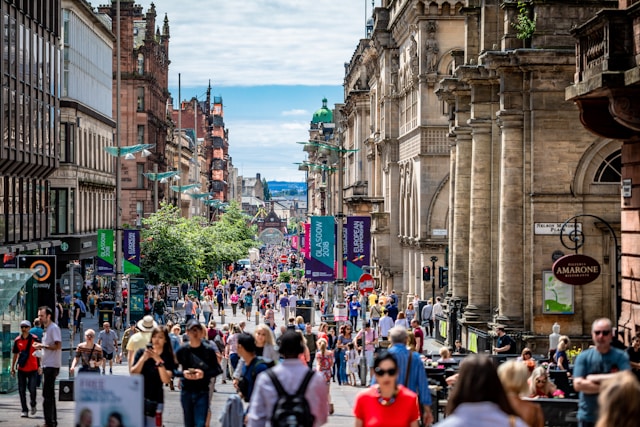
Buchanan Street, the city’s main shopping street, is pedestrianised, which makes it far easier to move along than streets shared with traffic. Bear in mind that it slopes uphill from Argyle Street towards the Royal Concert Hall.
At the bottom of the street, the St Enoch Centre is fully accessible for wheelchair users, with Blue Badge bays in the car park and step-free access from St Enoch Square via a lift. At the top, Buchanan Galleries has step-free entry through wide automatic doors, lifts to every level and accessible toilets on several floors. Both centres make good rest stops on a day in town, with seating and cafés inside.
Accessible Accommodation in Glasgow
Glasgow has a good range of hotels with accessible rooms, but standards vary, so check the details before you book. Useful features to ask about include step-free access from the street and car park, lifts to all floors, wet rooms or level-access showers, grab rails, and enough space to move around the bed and bathroom.
Photographs on booking sites do not always tell the full story, so contact the hotel directly and describe what you need. A quick phone call about door widths, bathroom layout or the distance from the lift to your room can save real frustration on arrival.
Eating Out: Accessible Restaurants and Cafés
Glasgow’s food scene is one of its strengths, and accessibility in restaurants has improved noticeably in recent years. Newer venues and chain restaurants usually offer level entrances, accessible toilets and space between tables, while some older tenement buildings still have a step at the door or toilets down a flight of stairs.
The safest approach is to check before you go. Many restaurants list access information on their websites, and Euan’s Guide, a review site written by and for disabled people, covers a growing number of Glasgow venues. If in doubt, ring ahead; most places are happy to help.
Mobility and Bathroom Accessibility at Home
Accessibility matters just as much at home as it does on a day out, and for many people the bathroom is where difficulties appear first. Climbing over the side of a bath becomes harder with age or reduced mobility, wet surfaces raise the risk of slips and falls, and standard bathrooms rarely include support rails or seating where they are needed.
These problems tend to build gradually, and many people put up with them for longer than they should. The right adaptations, such as a walk-in bath, a level-access shower or a full wet room, can restore independence and take away the daily worry of bathing safely.
Visit Our Glasgow Mobility Bathing Showroom
If you are based in or near Glasgow and thinking about adapting your bathroom, it helps to see the options in person before making any decisions. The Bathing Mobility Advisory Service showroom, inside Dobbies Garden Centre Braehead in Renfrew, displays a range of walk-in baths, walk-in showers and wet room options.
Visiting the showroom lets you try products for yourself, judge how easy they are to get in and out of, and talk through your situation with specialists who work with mobility bathing every day. There is no pressure to buy; the aim is to help you understand what would work in your home and for your needs. You can drop in during opening hours, call ahead on 0141 886 1408, or arrange a free home design visit if getting to the showroom is difficult.
Tips for Planning an Accessible Visit to Glasgow
A little preparation goes a long way:
- Plan your routes in advance, including where the lifts and accessible toilets are along the way.
- Check the venue’s own website or its AccessAble guide shortly before you visit. Access details change, and the official page is usually the most current.
- Travel outside peak hours where you can. Quieter buses, trains and museums are easier to move through, and staff have more time to help.
- Allow extra time between locations rather than packing the day too tightly. Rushing on slopes, cobbles or busy pavements is when accidents happen.

Glasgow is not a perfectly accessible city, but it is an increasingly good one, and its major museums, shopping centres and stations now set a high standard. With some planning, there is no reason to miss out on what the city has to offer.
And if it is your own home rather than a day out that needs to become more accessible, help is close by. Call into our Braehead showroom or get in touch for advice on walk-in baths, walk-in showers and wet rooms designed around you.